

Technique, for Spengler, doesn’t begin with the factory or the steam engine or even the forge. It begins with the animal. The moment a creature moves through the world with purpose, feeding, evading, or building, it exercises technique. What separates human technique from that of the beast is not the tool but the thought behind the tool. When primitive man stopped merely reacting to nature and began deliberately altering it, something decisive shifted in the history of life. The fixing of a determination became a purposeful act. It was language and number that crystallised this shift. Language names the hidden forces of nature and brings them within reach. Number abstracts the inner form of things away from their accidental, sensuous appearance. Together, they gave man what Spengler calls the power to switch nature on and off without ever understanding its secret. He compares the modern worker at a switchboard, or for us today, we could think about the computers on our desks and in our pockets, pressing buttons that summon tremendous effects he cannot explain, to human technique in general. We have always been sorcerers who know the spell without knowing what it conjures. The secret remains oppressive regardless.
This is the foundation on which the technique of the higher Cultures rises, and it is here that the great differences between them become visible. For each Culture expresses its technique in the colour and quality of its own soul, and nowhere is that contrast sharper than between the Classical and the Western.
Classical man was, in his very nature, a creature of the immediate and the visible. His world was Euclidean: bounded, stable, and perfectly present. He had, as a result, an instinctive hostility to technique in any meaningful sense. The trireme was a glorified rowing boat, and the catapult was a mechanical fist. When figures like Hero of Alexandria, who produced the Hero’s engine, stumbled across workable principles that might have transformed their world, they were treated as curiosities instead of discoveries. There was no inner weight behind them, no sense that these things had to be pursued. Classical man contemplated nature like Aristotle’s deity, at a remove, aesthetically, without the compulsion to master it. The deliberate form-poverty of the Doric column, which Spengler contrasts to the upward-straining ambition of Gothic architecture, tells you everything you need to know about how Classical man felt about reaching beyond what was immediately before him. Simple post and lintel structures fossilized from the early Iron Age into stone and became the spine of religious and secular architecture.
The Arabian Culture, which Spengler elsewhere calls Magian, took a different approach that was nonetheless equally remote from the Western spirit. The Magian sought nature’s secrets through alchemy, not to master nature but to coax its treasures away from it without effort. The Philosopher’s Stone, the elixir, the hidden sympathies between substances, these weren’t attempts to seize control of the world but to find passwords by which its wealth could be appropriated. It is a fundamentally passive relationship with nature dressed in mystical clothing.
But the Faustian West is something else entirely. From its earliest days in the Gothic period, Western man has felt the compulsion to master nature as a matter of instinct, as a matter of destiny. Spengler points to the early medieval monks as the true progenitors of Western science, men who wrestled God’s secrets from him through prayer, fasting, and relentless experimentation, and who felt no contradiction between this and their faith, because to understand the creation was to glorify the Creator. Roger Bacon speculated on steam engines and aircraft, Petrus Peregrinus dreamed of the perpetual motion machine, and Albertus Magnus lived in legend as a sorcerer. These men were the individual Fausts: discoverers who felt the profound danger of what they were doing and did it anyway. Spengler notes that the Devil always had a hand in the game. The sin these men risked was the ambition to replace God, to wrest his almightiness away from him, to hold causality in their own hands and direct it by their own will. Again and again, they succumbed to this ambition. Again and again, true belief condemned the machine as diabolical. But the Faustian soul could not stop itself.
This is the crucial distinction that separates Western technique from all that came before it. For the Faustian, theory and utilisation are never separate; insight and application are a matter of course. Where the Classical man contemplated and the Arabian sought to possess, the Western man experiments in order to act. The laboratory was always a workshop in disguise. Spengler traces this compulsion through the long chain of invention until it reaches the event that transformed everything: printing, the long-range weapon, the telescope, the microscope, the identification of chemical elements, then finally the steam engine.
With the steam engine, nature ceased to be a servant and became a slave. The muscle force of men had already been organised into routines. Now the organic reserves of the Earth itself, the life-forces of millions of years stored as coal, or for us, oil, were pressed into service. As horse-powers ran into millions, populations grew at a rate no previous Culture had imagined possible. Work became an ethical category. In the eighteenth century, it lost, across all Western languages, its old connotation of toil and degradation, and became the supreme human activity, the source of all value. The machine changed what it meant to be a person. Human life became precious because the machine insisted on being guided, and to guide it was to multiply one’s force a hundredfold.
What followed in the century of industrialisation is, Spengler argues, a drama so vast that future Cultures will look back on it with the conviction that nature herself was tottering. The earth was stitched over with railways and telegraph wires; continents were crossed in days, oceans in floating cities; mountains were bored through, rivers bridled, the force of gases harnessed into motion. The spoken word was sent across all oceans in a moment. Tiny man moved through halls of steel and glass as an unlimited monarch, and at the last, he felt nature not as something surrounding him but as something beneath him.
And yet, as this power grew, the machines themselves became stranger and less human. The wheels, rollers, and levers fell silent. All that mattered withdrew into the interior. The web of forces blanketing the earth, currents, tensions, invisible transmissions, grew ever more immaterial and ever more difficult to see or touch or explain. The machine had become, in Spengler’s eyes, genuinely mystical: a small cosmos obeying the will of man alone, delivered to him as though by a foreseeing omniscience. This is why, he insists, the instinct of true believers across every age has been to feel the machine as diabolical. It is not superstition. It is an accurate perception. The machine represents the deposition of God, the transfer of sacred causality into human hands. Man presses a button, the world moves, and he doesn’t know why.
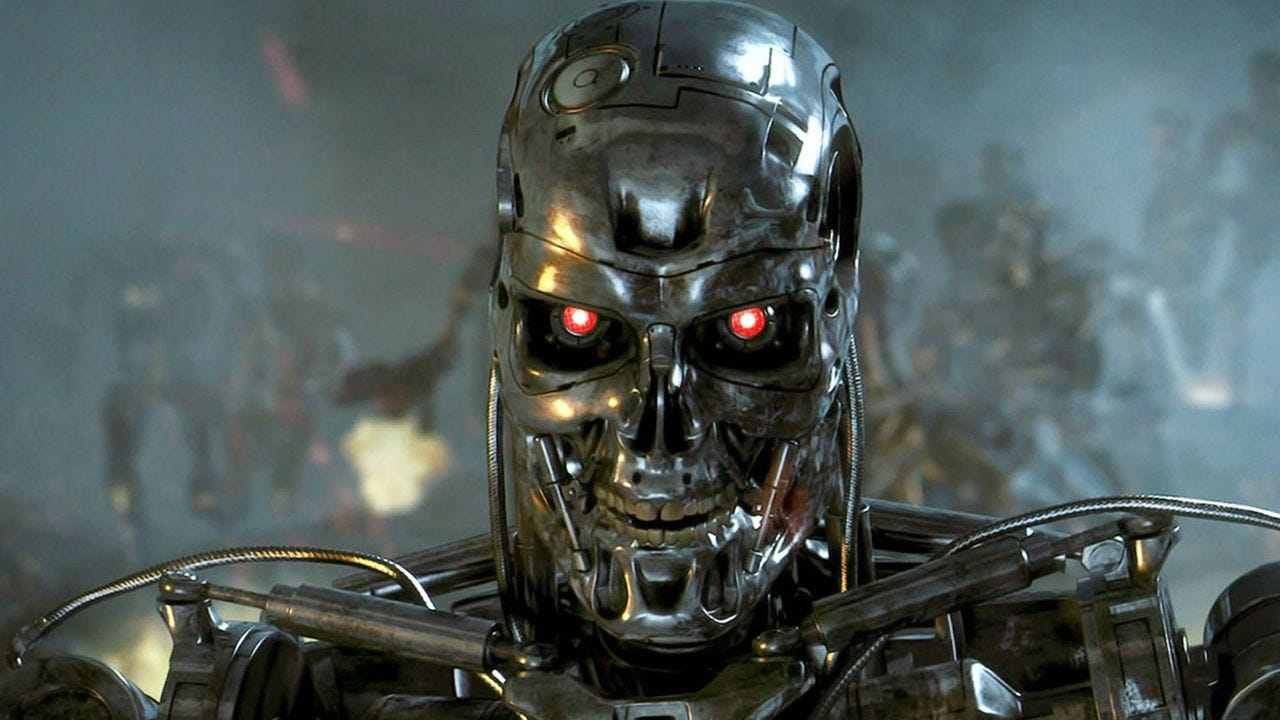
Since Spengler’s time, technology has only proceeded along this course. The Second World War produced the nuclear bomb, a device so destructive that it became the object of retrospective and forward-looking fear in art and politics. Japan’s culture has been almost entirely defined by Hiroshima and Nagasaki as the Fat Man and Little Boy became new deities to be feared. Simultaneously, AI can be looked at as the final obliteration of man’s knowledge. It sucks all previous creativity and knowledge into its own matrices and operates in ways that even the computer scientists who produced it fail to understand. This has created its own fear of runaway AI: a bottled waking consciousness that is capable of acting out of bounds and no longer listens to our commands. Since LLMs have become commonplace work tools that seemingly update every day, without even the time to produce art warning future mankind of its dangers, an air of fear about the next few years, let alone decades, has settled on our minds, a persistent anxiety that our own techniques may decide we know too much for it to risk, or too little for it to care for us.
This is where Spengler leaves us at the close of his analysis. At the pinnacle of Faustian achievement and at the threshold of its reckoning, the same soul that built the Gothic cathedral, that strove upward through Bach and Beethoven and Rembrandt, that sent ships to every ocean and ideas into every corner of the earth, has now fashioned a world that runs on its own momentum, obeying laws its makers don’t fully understand, serving ends they cannot fully foresee. Whether this represents fulfilment or overreach, whether the Faustian technocrat is Prometheus or merely Faust, waiting for the bill to come due, is the question that will haunt everything that follows.