
Narrative Collapse and Caesarism
Experimenting with a more dynamic style of writing

On Christmas Day in the year 800 AD. Pope Leo III crowned Charlemagne as “Emperor of the Romans” at St. Peter’s Basilica, establishing the foundations of what would become the Holy Roman Empire. The reason for this was mutual dependence; Charlemagne lacked an ultimate legitimizing title for his claim over most of Western Europe, and the Pope needed protection after coming close to being deprived of his seat. So, the bargain was struck that the church would receive protection from the king of the Franks and the Pope would make Charlemagne and his empire the worldly protectors of the church. This was the seed that eventually flowered into Faustian culture.
But this was not a unique or unusual affair for complex cultures. In Greece, the Homeric cults gave legitimacy to the Oligarchs of the polis. In China, the Shang and Chou dynasties were the spiritual bridges between heaven and earth. At the battle of the Milvian bridge, we are told by Eusebius that Constantine received a dream where he was instructed to put the letters “χ” and “ρ” on his army’s shields if he wished to win; in doing so, he became the first Christian emperor.
The political world is governed by facts. Facts are momentary and are weighed by their value as opportunities to take. One plus one is not valuable to a politician unless he benefits from stating it. But the spiritual world, which is the precursor of all science, philosophy, and mathematics of increasing intellectual rigor, is governed by Truths. Truths are weighed by whether or not they are immutably correct or incorrect, whatever that means from culture to culture.
Spengler is adamant that Truths don’t exist in politics. When they do exist, they are resistances in the flow of operations. All politics is a form of war from the debating chamber to the battlefield, so if one sticks by their principles because they are “right”, whilst the other betrays his principles because he will win, then naturally the latter will defeat the former in most instances. Sometimes this can be avoided if the former man is stronger, but there lies the admission that truths are a luxury when strength and power management is the real worldly language.
But a man who breaks all laws and betrays all oaths is a man who can’t be trusted. He is only out for himself and his peers, if any, and so the natural end of a man like this is he is killed by the men he alienates. The Western iteration of this idea is the social contract and it was debated alongside human nature through the whole Baroque and Industrial era. Men agree that the state of nature is less preferable due to its chaos than an orderly society, so we all agree to follow laws, treaties, rules, agreements, etc., so we guarantee a sense of safety and trust to one other.
And what are laws if not fixed connections that are immutably valid? Truths are the best form of treaty because when two people agree one plus one is two, we can cooperate on unchanging logic and not just shifting power dynamics. This is why it is so integral that in a society, we all speak the same language, have the same foundational principles and spiritual intuitions about the world, because without this we can’t agree on the most powerful form of social contract and organise society on a mass scale.
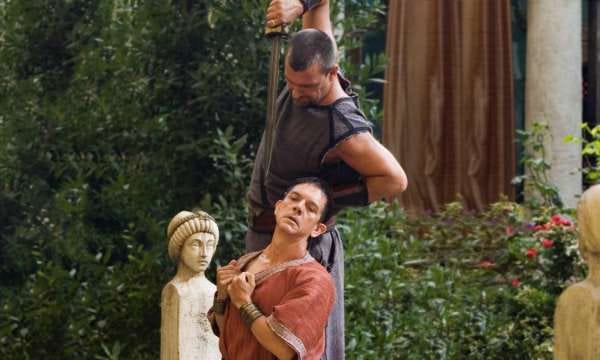
On the opposite end of civilisation’s course, I have another story to tell. Cicero was an ideologue. He relied heavily on first principles to build up systems defending the republic and stoic ethics and political theory. He was a writer and an orator, and used these skills to attack Mark Anthony after Caesar’s assassination. He wasn’t a very good politician, and tried to play Anthony and Octavian off of each other in a scheme to restore the republic. What he didn’t account for though was how readily these two men were able to bypass the rules and institutions with their militaries and create kill lists, upon Mark Anthony’s list being Cicero. His head and hands were nailed to the Rostra in the forum, the platform where he delivered his speeches against Anthony, and afterwards, his head was sent to Alexandria where Anthony’s wife Fulvia pulled out his tongue and stabbed his head repeatedly. Spengler called the murder of Julius Caesar the last gasp of the Apollinian spirit, but Cicero’s death was where its heart stopped beating, and from then on, the Western half of the Empire slowly descended into increased barbarism and petty conflict until its termination in the 5th century.
Augustus’ reign was of necessity intertwined with the image of spiritual legitimacy, but already the lie had revealed itself, and this only got more and more obvious with every emperor that took the purple. Caesarism is Spengler’s attempt at piercing through the bullshit and identifying that history ends without belief in anything but pure force politics. At first, a historian may trouble himself with a man like Augustus to find any trace of this, but with each of the Julio-Claudians it became increasingly apparent how dependent the system was on blunt force to maintain each ruler, and after Nero’s death it was alarming how quickly the empire got torn apart over who got to call the shots.
I’ve alluded in other posts to where we are today and how Caesarism is on our doorstep. If you are under 30, you’ll probably live to see our Julius Caesar, although you probably won’t realise it’s him. If we’re going by exact year-dating, 2017 was the year of Tiberius Gracchus, an anti-establishment candidate who got rug pulled by the equites – big money – and was ultimately assassinated. 2106 will be the assassination of Caesar and 2119 will be our battle of Actium. These events could be slower or quicker by a few decades because although academics insist Spengler is some kind of determinist, these events are destined to happen and are not causally bound, and with how things are going I think we are likely to have our Cicero event long before 2100. Even now we are feeling the effects of a society that is losing its grounding in truth, and unlike previous arrangements, this narrative collapse will be existential and plumet us into Caesarean conditions.
Since World War Two, there has been a new social contract defined by an uncompromising piety towards liberal principles. This rules-based order has been maintained, not by the self-evidence of its tenets, or its harmony with human nature, but by identifying its truths as the objective of politics itself and maintaining this narrative through non-stop media production. The Cold War is sufficiently behind us to recognise that it was a period of constant propaganda. In fact, outside of the various proxy conflicts, the tensions between America and Russia were simply a culture war between two narratives trying to make claim to the post-war consensus. Intelligence networks shaping public opinion through false flags, Bernaysian public relations campaigns, billionaire and government financing of political magazines at Ivy league colleges, court cases over the historical authenticity of events, newspapers, radios, television – wherever you went you were subject to a narrative war which culminated in the “end of history”, or American Liberalism’s victory.
At the same time, the American Left were accelerating the presuppositions of this consensus. Critical theory and post modernism aimed to psychologise our history and identity. If Spengler lived through to the 60s and 70s, he would have been happy to identify this academic movement as what he coined “physiognomic scepticism” in the last words of volume one chapter ten.
“And there remains the possibility of a third and last stage of Western philosophy, that of a physiognomic scepticism. The secret of the world appears successively as a knowledge problem, a valuation problem and a form problem. Kant saw Ethics as an object of knowledge, the 19th Century saw it as an object of valuation. The Sceptic would deal with both simply as the historical expression of a Culture.” - Vol.1, p.374.
What the likes of Foucault and Derrida were pursuing might be interpreted today as a kind of nihilism towards philosophy, but in a way, they were completing it, or at the very least playing their part in the symphony. Faustian man had to liberate himself from the final constraints of the body – sex became gender, sexuality became a spectrum, race became a construct, and correspondingly, family became oppression, homophobia became a projection, and nationality became the way-paver to genocide.
Today, the modern social contract regards truly traditional and nationalistic beliefs as the real state of nature. We are cancer cells to be avoided or challenged, and at all costs guarded against in the halls of power, because to them we represent the disloyal man who threatens to undo that social contract. It was founded on the first principles of individual liberty, democracy, and speaking truth to power, and has been since fought for and woven together into a complex narrative that treats any other rule set as paving the way towards the ultimate evil – the Holocaust.
If it can be called Liberalism, because it certainly isn’t the Liberalism of the British Empire, it hides behind the authority of the truth to justify its actions. We trust the experts on our TVs and X feeds because surely, since they have the peer-reviewed, tried and tested, scientific truth, we can trust our politicians who hide behind them to govern righteously and free from corruption. However, particularly with the rise of social media, there has been a wave of Protestantism towards official narratives. This comes in the form of very niche communities forming through global communications, often using theorycel blogs and forums more than academic research, conspiracy talk, and also populist scrutiny of every facet of the “establishment”, particularly on the dissident right, which finds itself unconditionally excluded and shunned for the above reasons. This seems to be enough to sow narrative doubt in the prevailing establishment, especially after it makes critical blunders surrounding these narratives. COVID exposed the dangers of relying on government-approved experts. The Epstein files have recently exposed the insincerity of our political class as they try to present themselves as moral while harming our youngest. Israel’s genocide shows us just how futile our “rules-based order” really is at stopping the very thing it is meant to be preventing. And among all of this, the response from our elites is not dialogue, not freedom, but active measures and clamp-downs on speech. The cracks are beginning to show.
Before we jump into the future effects of this, let’s diagnose why we live under this peculiar regime. As I have stated, the existing order depends not on its own self evidence as much as it focuses on air-tight narratives to keep afloat. Spengler goes on at length explaining the principles of politics. The world-as-history is organised into “forms”, groups that are bound together by self-evident and emotional conviction. But when a group loses that inner confidence, it either dissolves or substitutes that uncertainty for constitutional elements, and its character as a movement in history is substituted for the stability of constitutions, laws, writing, and truths in the world-as-nature. It shouldn’t have to be said that you shouldn’t litter, yet our pavements are covered in dried gum all the same. So, we might make laws declaring it is wrong to do so, and there will be a cause-effect process whereby littering will result in a £100 fine if you are caught. A country like Japan’s streets are completely clean, so such a law isn’t particularly necessary there, but when you live in a society full of people who don’t feel they are part of it anymore, you have to declare outright what will be and won’t be expected of them in an increasingly authoritative manner. Countries that are completely lacking in form apply this to every facet of society and become bloated machines enforcing how things ought to be according to a wholly philosophical and impractical set of behaviours. The very fact that our governments have to wage information wars against us evidences the stagnant condition of our countries, as no one is naturally convinced of its legitimacy, and this is made all the worse when what is forced upon us is alien and antithetical to the intuitive principles of national self-interest.
“And now bills were passed, not only for national objects but for individual cases, and laws were most numerous when the commonwealth was most corrupt.” – Tacitus, Annals Book 3, Chapter 27
Political narratives are just a substitute for being in form, a religious creation myth in the place of genuine politics, and the modern world is so dependent on these narratives that there is almost nothing to catch us if they fall apart. Because of this, whereas in another time the people may band together and overthrow the system, people retreat. There is no alternative vision for a collective future. When it turns out that the entire system is designed for psychopaths to rape and eat our children, and permit foreigners to rape and eat our children, one feels slightly alienated from the process. But this also extends to every instance where power contradicts the sensibilities we are indoctrinated with. One can imagine how deflated the plebs were when Tiberius Gracchus, whose potential for popular reform was unmatched, was simply winded and assassinated before them. Each time something like this happens, the narrative of how the world works, what is true and moral, and what is to be expected with regard to fairness and honour, is permanently damaged.
This process has been happening long before anything evil was exposed. A survey by the Office of National Statistics shows us that nearly half (44%) of participants said they had little or no confidence in their ability to participate in politics. Most people (63%) had little or no confidence that they have a say in what the government does. Two-thirds of participants were also clear that there is a correlation between their trust in a government and the leadership’s ability to abide by the rules everyone else does. Starmer’s office only got into power because of the growth of voter apathy in that particular year, giving him less of a mandate than Brexit, for which there were continuous protests against. It is pure luck on our part that some of the schemes they created that we petitioned against, only to be bypassed anyway, fell apart. The feeling each year that voting won’t solve anything has come to a point where an insider like Dominic Cummings can say that if Reform don’t fix the country, people are going to shift their focus towards getting their children out, because when the promise fails, and the narrative collapses after forcing its way into everything, people simply give up on political solutions and pivot towards their private worlds.
It is in this flowerbed that Caesarism begins to grow. Caesarism isn’t a type of man at the top, it’s a civilisation-wide attitude that 1., truth in politics was always a lie, 2., idealism is punished by power, and 3., if politics is not for the good, then it defaults to being about who has the power and who doesn’t. The situation is managed as it is because anything outside of your immediate condition is beyond your control. National interests therefore devolve to regional interests, then local interests, then personal interests, all while on the surface, the laws and systems, created by a religion no one has faith in anymore, stay in place. Spengler draws comparisons between Caesarism and some of the great men of the absolute state period, such as Oliver Cromwell, but what separates them is the lack of underlying form. In Cromwell’s age, there was an energy cultivated by a sense of race (Spengler’s conception of race) and national identity which meant that if one man fell, ten more could take his place because everyone unconsciously understood the assignment. But Caesarism emerges out of a period where the death of form has been obscured by ideology, narrative, philosophy, constitutions, laws, truths, and lies that slowly replaced the ship plank by plank before finally rotting away and leaving nothing to work with. When these narratives collapse, there is no driving force outside of what this or that great man may do for you.
This needs to be understood as we go into the deep of this century. Behind the promise of multiculturalism, anti-racism, and a progressive future is a network of hundreds of thousands of self-invested individual bureaucrats and corporate figures who don’t want to lose their corrupt positions. They are not in form as a group but are only saving their own asses. Like Trump and T. Gracchus, they are the proto-Caesars, just in the opposite camp to them. The only thing justifying their positions is a shredded narrative about why they are there in the first place, but every year, a new scandal trips them up and exposes the corruption. They tripped up Musk while keeping Thiel; they will do the same to Reform as they did to Trump 1.0. Fighting against this purely with an ideological narrative of our own is futile because 1., the age we are entering into is a post-narrative age, and 2., when the establishment is exposed, it only leaves the people to create a million conspiracy narratives of their own which all point to a gnostic second-religiousness that tells us “It’s all too futile to stop them”. This leaves future history back in the hands of elite factions, which steadily consolidate in individual men who are powerful enough to dismantle the system and “restore the republic” through empowering themselves and their families alone, regardless as to how many of us it will hurt. In that grain of knowledge is the path forward.
I wanted to experiment with a post that isnt just a simplification of what Spengler has already written, and I figured he didn’t do a good job at clarifying the internal politics of the transition into Caesarism.
I like this. Keep writing please! I don't get to talk about Spengler enough.
One quibble (if I've understood you correctly): I'm not sure that Caesarism is just a nihilistic attitude of post-idealism power politics. That may be the true reality underneath it, but it is driven by a continuing idealism amongst people, who see the bureaucratic obstructionism of The Blob and think 'we just need a single, dynamic, strong leader to cut through all this nonsense and then we could resolve all our problems'.
Cummings got Boris Johnson to drive that forklift truck through a pile of boxes marked 'Get Brexit Done' as a way of tapping into this vibe. Trump is obviously also the same thing. "If Stalin only knew" etc. It's an attitude of 'shurely it can be simpler than this, shurely there's an easy solution, someone just needs to take charge and we'll get this place back on track in no time'. At least at the beginning.
Really it's a reversion to an earlier state, like a water-stressed tree consolidating its energy in the central trunk and letting the most-recently grown branches die. Previously there was a king as a central, human focus for the power-flows of the state. Then things complexified and the centre became virtualised - 'the republic', or in the UK's case 'the crown' (rather than the monarch themselves). And now that people no longer trust in that invisible centre made out of ideals, they need a human figure to occupy the space again to reassure them that there is still a centre around which the possibility of the society being 'in form' can organise itself.
That history cannot go backwards, that the central figure will not be able to keep the society in form or revive the ideals that structured it, only becomes apparent later.
https://substack.com/@stevenberger/note/c-211587570?r=1nm0v2&utm_source=notes-share-action&utm_medium=web